I don't know how this happened. I've become locked out of my blog. I changed the title a bit and now I cannot find how to open the blog again to make some changes. this tools part is the only entrance and I am trying to widen it. Ric.
How can it be that Australia, a nation whose self-image is of fairness, frankness, and anti-authoritarianism, is so cruel to asylum seekers? It would be better to ask whether the current regime of imprisonment and torture is anything new. It is, after all, the latest in a long history of Australian cruelty, a constant presence in our culture since white settlement.
The usual fallback is to blame a lack of political and moral leadership, a series of "lurches to the right", or a "dark victory". The Greens, who brand themselves as the compassionate party, claim that they could do better – if only they could take government. But isn't it strange that we lay the burden of "fixing" the asylum seeker gulags issue at the feet of parliamentarians, the same group of people who decided to lock them up to begin with?
To say it's even possible to fix gives the parliament too much credit. More powerful nations, whose immigration flows are comparably much higher, end up conducting their debates along the exact same lines as us. This includes governments run by the left; as I wrote earlier this year for ABC Religion, the French in particular have often been cruellest under socialist leaders, including François Mitterrand.
That said, Operation Sovereign Borders is barbaric in an authentically Australian mode, given our early history of offshore penal settlements like Norfolk Island and Port Arthur. Unfortunately, because nobody bothers to read Australian history, we mainly access the memory of these colonial torture chambers through a popular myth: that convicts who were skilful, hard working and well behaved in the early settlement period were given tickets-of-leave and made a new life (including as constables and barristers), while the baddies, murderers and repeat offenders were shipped off to Norfolk to be flogged and tortured.
Like much of our officially permitted myth-making, this picture of Australian history is a useful fiction that validates current political arrangements. After all, if it wasn't useful, wouldn't it just be forgotten?
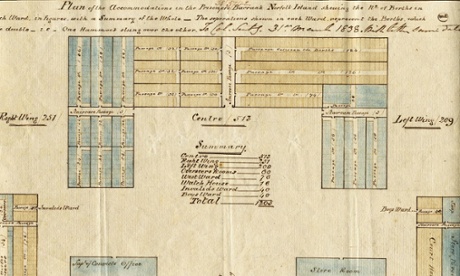
Plan of the accomodation of convicts in Norfolk island. Photograph: /State Records NSW/FlickR
A 2010 study of over 6,000 convict records by Tim Causer, the largest to date, found that the overwhelming majority were not professional felons, but unskilled labourers.
Nearly 70% had been brought to Australia after committing non-violent property offences. Two-thirds had only been punished a single time before their original transportation to Australia, which according to Causer's reading of the records, could mean "anything from 10 years in prison (a rare sentence) to a couple of days locked up for drunkenness." In other words, the prisoners at Norfolk Island, Port Arthur and the rest were for the most part ordinary labouring men.
Other early settlement histories have come to a similar point. Nonetheless, the myth of the felonry, the criminal class and the lash has defeated one revisionist historian after another. It retains its stranglehold over the Australian imagination in part because, like all myths, it establishes a false moral order: that good character and hard work were enough to avoid punishment in the colony. It wasn't true then, and at heart we know it's not true now.
Unexceptional people were sent to Norfolk as a matter of course, and as a result were treated with exceptional cruelty - not to deter criminals (which the Australian penal settlements failed to do), but to maintain and justify a regime of arbitrary low-level cruelty against the rest of the transported convicts on the mainland.
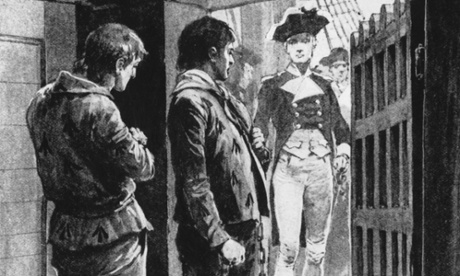
Convicts on a ship bound for Botany Bay, Australia. Photograph: Hulton Archive/Getty Images
However, those under the lash did not cease to see themselves as British subjects: punishment tends to breed loyalty to an established social order, rather than encourage rebellion. This is why nobody bothers to read classic Australian fiction, which at its best is anti-colonial and anti-establishment. We no longer know how to find it enjoyable, and that's a shame, because it offers a clear vantage point from which to view our current situation.
In the pivotal scene of Marcus Clarke's classic convict novel, For The Term Of His Natural Life, Kirkland (a convict up for a flogging) encourages the protagonist Rufus Dawes to deliver his punishment: "'Go on, Dawes,' whispered Kirkland, without turning his head. 'You are no more than another man.'"
Dawes, also a prisoner, stops after 50 lashes. "I’ll flog no more", he says. "Get someone else to do your blood work for you. I won’t.” He himself is tied to the triangle for Kirkland's share plus a few dozen more. Then the novel's real scandal occurs:
"For 20 lashes more Dawes was mute, and then the agony forced from his labouring breast a hideous cry. But it was not a cry for mercy ... He cursed all soldiers for tyrants, all parsons for hypocrites. He blasphemed his God and his Saviour. With a frightful outpouring of obscenity and blasphemy, he called on the earth to gape and swallow his persecutors..."
Dawes, by condemning the pointless and arbitrary colonial order that forces him to terrorise one of his fellows, is the novel's hero.
By contrast, North, the priest and "establishment humanitarian" character (tellingly also a "confirmed drunkard", or by today's lax standards, a hipster epicure) fails in his pledge to save Kirkland from the lash. He instead turns up halfway through hungover, and finds himself delighting in the spectacle: "He would fain have fled, but a horrible fascination held him back."
The tragedy of Operation Sovereign Borders is that it descends even further from this awful scene. The asylum seekers on Nauru and Christmas Island are not even punished as part of the established legal order, becoming subjects of the state as a result of their suffering. The federal government refuses to recognise their personhood as attracting inherent legal rights, which permits them to be maltreated. It is little wonder that they want to die, they are not even seen as human beings by the authority to which they want to submit themselves.
If we accept this description of asylum seekers (what Agamben calls homo sacer) then the spectacle of members of parliament crying over asylum seekers who drowned off Christmas Island was nothing more than unadulterated narcissism: "It makes me, a powerful elected member of government, upset to see that the legal structure I help perpetuate causes an utterly powerless person to either drown or be tortured."
They are actually worse than North, who in Clarke's novel at least has the decency to be ashamed at his failure. When he cries "No. Not if you are Christians!" at the sight of Kirkland's flogging, he does not look for validation from those around him – unlike our MPs, who were no doubt glad to receive praise for their tears.
Immigration minister Scott Morrison's decisions are even more loathsome, because he hides his gleeful administration of Operation Sovereign Borders behind a range of military and parliamentary processes. It would be more honest for him to be more like Marcus Clarke's commandant Burgess, who laughs while Dawes is flogged, taking direct pleasure in doing his duty.
"But it's sick to enjoy that!" you say. Yes, it is. So why do you support a system that delivered Morrison to power? Because it's the parliament?
"The parliament has to do all kinds of distasteful things. That doesn't mean we enjoy it", you reply. Really? So much for the rule of law – the asylum seekers haven't committed a crime!
"Yes they have, they came illegally." Even if that were the case, so did your ancestors – and they were treated the same way. That's the trained outburst of a broken person, who identifies with the authority that dominates him rather than with justice – not the words of a natural bigot.
Why is Australian culture cruel? Because that's the behaviour our cruel state demands from us to show loyalty.
Please note: Some internet providers including Internet Explorer and even Firefox seem to delete aspects of my blogs. I have found only one, CHROME to be satisfactory.Please down load CHROME in a couple of minutes (free). thank you (Ric)

Have a beer, mate! We got barbecued crocodile on the menu tomorrow and gutted galah on Wednesday. All kinds of tucker for the sophisticated bushie. DEAD SNAKE SNACK BAR, King's Bloody Cross.
Crimes punishable by transportation included recommending that politicians get paid, starting a union, stealing fish from a river or pond, embezzlement, receiving or buying stolen goods, setting fire to underwood, petty theft, or being suspected of supporting Irish terrorism.
The song made famous by the late Slim Dusty, was first written in the original Day Dawn Hotel in Ingham in north Queensland in 1943, by an Irish cane cutter Dan Sheahan, after some American soldiers drank the pub dry the previous night. > >
Feb. 1, 2012 Courtesy of Nature and World Science staff
Australia may need an infusion of elephants and other large mammals to solve its persistent ecological and wildfire problems, a scientist proposes.
Ecologist David Bowman of the University of Tasmania in Australia cites out-of-control fires and burgeoning feral-animal populations as quandaries afflicting the Land Down Under. Both could be solved by introducing large mammals, as well as paying aboriginal hunters to control the feral animals and restore the old practice of patch burning, he argues. Patch burning is a form of controlled burning intended to clean out and renew biological resources.
“I realize that there are major risks associated with what I am proposing,” as any tinkering with the environment can lead to unplanned consequences, said Bowman. “But the usual approaches to managing these issues aren’t working.”
Bowman describes his idea in this week’s issue of the research journalNature.
Feb. 7 will mark the three-year anniversary of “Black Saturday,” when nearly 200 people died in a massive firestorm in southern Australia. Fires are a constant concern in the continent, said Bowman, but so are its thriving populations of feral pigs, camels, horses and cattle, among others.
Bowman proposes to manage Australia’s troubled ecosystem by introducing beasts such as elephants, rhinoceros and even Komodo dragons. These would help consume flammable grasses and control feral-animal populations, he argues.
The largest living land mammal native to Australia is the red kangaroo, which as an adult weighs about as much as an average man. Larger mammals used to roam the continent—such as a hippo-sized marsupial related to the wombat and called diprotodon, from the Great Ice Age—but they are no more.
The deliberate introduction by humans of populations of oversized, non-native mammals to a new continent would be unprecedented in modern times. One group, though, has proposed introducing large African mammals into the Great Plains of the United States, for somewhat different reasons than those motivating Bowman.
Carol Baxter is my distant cousin. She has not directly contributed to this weblog, and has not ever in fact acknowledged its existence, but because of the valuable information I received from reading her website about our family, I am very indebted to her.
Another family website helped me considerably. This was "Our Williams Story" by another distant cousin, Kieran Williams
I am heartened by the many emerging websites about the descendants of William Nash and Maria Haynes.
Then there are the many threads from Monaro Pioneers.
Thank you for all the sources.
I am hoping that when I am no longer able to continue (being nearly 79) that someone else wll pick up the ball and continue my blog.Of course I have included my political views and my non-religious attitudes because they are part of me and readers do not have to accept them, but may actually learn a little from them.
William Nash came to Australia as a Marine with the First Fleet 1788 William and Mariah's first child, William, was baptised on Sunday 25th May 1788 A wedding was celebrated at St Phillip's, Sydney, on 13 February 1789, between William Nash, a marine, and Maria Haynes, a convict, in the presence of Elizabeth Gratten and Samuel Barnes (Chaplain's clerk) Mariah Haynes is not listed in John Cobley's 'Crimes of the First Fleet Convicts' By 1803 William & Maria had separated, and she took the children with her. Maria later became associated with two other men, Robert Guy and in 1816, with William Neale.
6 Children
1. William Nash born on 25 May 1788, buried on Friday 19th June 1789, a marine's child. 2. John Nash baptised 15 Jan 1792 (a family source names him William) 3. Mary Nash born 2 March 1793 and baptised 2 April 4. William Nash born 27 March 1795 and baptised 4 May 5. George Nash born 26 July 1797 6. Sarah Nash was born 16 Nov 1798
6. Sarah Nash 16 Nov 1798 wed on the 15th January 1814 at St John's, Parramatta, to John Williams (a convict), 13 children
On 25th April 2010 Stephen Hawking, leading academic and cosmologist, told the Sunday Times: “We only have to look at ourselves to see how intelligent life might develop into something we wouldn’t want to meet. I imagine they might exist in massive ships, having used up all the resources from their home planet. Such advanced aliens would perhaps become nomads, looking to conquer and colonise whatever planets they can reach.” He also points out that making contact with aliens could be very risky, stating: “If aliens ever visit us, I think the outcome would be much as when Christopher Columbus first landed in America, which didn’t turn out very well for the Native Americans.”
(below:)Convicts on way to 14 years penal servitude in Botany Bay. England's loss was Australia's gain. Most had committed crimes that would get them now only a fine.
John Kerswell: A Welsh plasterer transported in 1828 at the age of 20 years to 15 years for stealing. Absconding four times and charged with being drunk three times, granted ToL in 1856 and Conditional Pardon in 1857. However, he received 20 years imprisonment for attempting to stab a policeman. He was released from Port Arthur in 1875.
William Forster: At age 17 years was transported for ten years for stealing a box writing desk. Misdemeanour followed misdemeanour and sentence added to sentence until in 1864 he was sentnenced to life for robbery under arms. The last mention of him is in 1872 when he was sent to the Separate Prison for misconduct.
Alexander Woods: A soldier with the 17th Regiment, Aberdeenshire, Scotland, Woods (aged 30) was transported from Canada to Port Arthur for 14 years for desertion. Returned to Hobart with a ToL in 1853 but returned to PA again in 1865 for 15 years for burglary. He was a church attendant in 1869 and was discharged in 1875.
Gropecunt Lane was a name used in Oxford, London and other Englishtowns and cities in the Middle Ages for streets where prostitutes conducted their business. The name derives from cunt, the Middle English term forfemale genitalia, and the act of groping. There was also a Gropecunt Lane inDublin, Ireland near where the Savoy Cinema is now. Later sensibilities changed many names of streets bearing this name to more polite variations.
In London, the street that was Gropecunt Lane was near the present-day site of the Barbican Centre in the City of London. The street was called Grub Street in the 18th century, but renamed Milton Street in 1830 . Another street with a similar history in Southwark is Horselydown Lane ("whores lie down"), which is just to the south of Tower Bridge, and was also the site of the famousAnchor Brewhouse.
(Dallas Darling is the author of Politics 501: An A-Z Reading on Conscientious Political Thought and Action, Some Nations Above God: 52 Weekly Reflections On Modern-Day Imperialism, Militarism, And Consumerism in the Context of John's Apocalyptic Vision, and The Other Side Of Christianity: Reflections on Faith, Politics, Spirituality, History, and Peace. He is a correspondent for www.worldnews.com. You can read more of Dallas' writings at www.beverlydarling.com and wn.com//dallasdarling.)
is a patronymic form of the name William that originated in medieval England[2] and later came to be extremely popular in Wales. The meaning is derived from son or descendant of Guillemin, the French form of William. Derived from an Old French given name with Germanicelements; will = desire, will; and helm = helmet, protection.[3] It is the second most common surname in Wales and the third most common surname in the whole of the United Kingdom, the third most common in the United States of America and Australia and the fifth most common inNew Zealand.[4]
Old Harry Williams was asked how was it that the long list of Williams lead by far those of Nash over the last couple of hundred years.
"Well, let's see.Them Nashes they was more posh and they kept the family bible, so we lot had nothing to read at night.There was no T.V. in them days, and we didn't want to waste candles, so we used to all jump in bed together and make more Williams's."
Australia. The first fleet sailed from England in 1787 carrying marine William Nash and his common law wife Maria Haynes. They were the progenitors of an extensive Nash family in Australia. Another early settler was Andrew Nash. He had acquired the Woolpack Inn in Parramatta in 1821 and became well-known for the prowess of his racehorses. A later settler from Wiltshire was James Nash. He discovered gold along the Mary river in Queenland and helped precipitate the second Australian gold rush.
There were also Nash convicts in Australia. Some thrived; Robert Nash, transported on the Albemarle in 1791; John Nash on the Eleanor in 1831; and Michael Nash from Limerick, on the Rodney in 1851.
If a man was on an escalator, but walking back down it and the elevator was located in a revolving restaurant on a large airliner going in a southerly direction and the earth was revolving on its axis and at the same time was travelling in an elliptical path around the sun, which was travelling around the galaxy, which was expanding......how many movements was the man travelling in?
I met Michael (Tarzan) Fomenko(shown here at 81 years) son of a Russian Princess when I was 18 and he was twenty. He was a handsome young man. I was in love with his sister Nina Fomenko, who was gracious to me but held my ardour at arms' length. In later years I met her in North Queensland where she and her husband Brian Patrick Donnellan were cutting cane. They had no mattress to sleep on, so I bought them one. Nina was always beautiful. (Ric)
Toonoom Falls Situated in the heart of Royal National Park to the south of Sydney, Toonoum Falls is a pretty, 5 metre high waterfall alongside Sir Bertram Steven Drive not far from the Garie turnoff. The photo shows the falls in flood. Location: Royal National Park.
In the fifties, I lived close to here in a rock shelter once used by Aborigines. I used to swim in this creek a little further down the hill. My family thought I was crazy and I probably was, but life here on the edge of the National Park was idyllic if you could bear the flies, mosquitoes, snakes and centipedes.. (Ric)
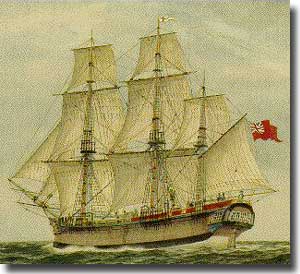
HMSSirius, the main Naval ship with the First Fleet, under Captain John Hunter RN. Had been built in 1780 as Berwick for the East Indies run, badly burned in a fire, and rebuilt by Navy, renamed Sirius, finally wrecked off Norfolk Island on the 14th. of April 1790.
*The Australian Lyre Bird is the world's best imitator; able to mimic the calls of 15 different species of birds in their locality and string the calls into a melody. Also been known to mimic the sound mobile phones.
*The echidna is such a unique animal that it is classified in a special class of mammals known asmonotremes, which it shares only with the platypus. The echidna lays eggs like a duck but suckles its young in a pouch like a kangaroo. For no apparent reason, it may decide to conserve energy by dropping its body temperature to 4 degrees and remain at that temperature from 4 to 120 days. Lab experiments have shown that the echidna is more intelligent that a cat and it has been seen using its spikes, feet and beaks to climb up crevices like a mountaineer edging up a rock chimney.
*Purple wallaby - The Purple-neck Rock Wallaby [Petrogale Purpureicollis], inhabits the Mt Isa region in Northwest Queensland. The Wallaby secretes a dye that transforms its face and neck into colours ranging from light pink to bright purple.
*The Fierce Snake or Inland Taipan has the most toxic venom of any snake. Maximum yield recorded (for one bite) is 110mg. That would probably be enough to kill over 100 people or 250,000 mice.
*The Wombat deposits square poos on logs, rocks and even upright sticks that it uses tomark its territory.
*A 10kg Tasmanian Devil is able to exert the same biting pressure as a 40kg dog. It can also eat almost a third of its body weight in a single feeding.
*Australia is the smallest, flattest, and driest inhabited continent in the world. It is the only country which is also a whole continent.
*Over 90% of Australia is dry, flat and arid. Almost three-quarters of the land cannot support agriculture in any form.
*A baby kangaroo at the time of its birth measures 2 centimetres.
*Kangaroos need very little water to survive and are capable of going for months without drinking at all. When they do need water, they dig 'wells' for themselves; frequently going as deep as three or four feet. These 'kangaroo pits' are a common source of water for other animals living in the kangaroo's environment.
*A kangaroo being chased by a dog may jump into a dam. If the dog gives chase, the kangaroo may turn towards the dog, then use its paws to push the dogs head underwater in order to drown it.
*Emus and kangaroos cannot walk backwards, and are on the Australian coat of arms for that reason.
*A monotreme is a animal that lays eggs and suckles its young. The world's only monotremes are the platypus and the echidna.
*The male platypus has a poisonous spine that can kill a dog and inflict immense pain on a human.
*When a specimen of the platypus was first sent to England, it was believed the Australians had played a joke by sewing the bill of a duck onto a rat.
*Box Jelly fish - The box jellyfish is considered the world's most venomous marine creature. The box jellyfish has killed more people in Australia than stonefish, sharks and crocodiles combined.
*The Sydney Funnelweb spider is considered the world's most deadly spider. It is the only spider that has killed people in less than 2 hours. Its fangs are powerful enough to bite through gloves and fingernails. The only animals without immunity to the funnelweb's venom are humans and monkeys.
*Lung fish - Queensland is home to lung fish, a living fossil from the Triassic period 350 million years ago.
*It is estimated that by the time transportation ended in 1868, 40 per cent of Australia's English-speaking population were convicts.*A census taken in 1828 found that half the population of NSW were Convicts, and that former Convicts made up nearly half of the free population.
*In 2007, it was estimated that 22 per cent of living Australians had a convict ancestor.
*Convicts were not sent to Australia for serious crimes. Serious crimes, such as murder, rape, or impersonating an Egyptian were given the death sentence in England.
*Crimes punishable by transportation included recommending that politicians get paid, starting a union, stealing fish from a river or pond, embezzlement, receiving or buying stolen goods, setting fire to underwood, petty theft, or being suspected of supporting Irish terrorism.
* Alcohol- It has been reported that the first European settlers in Australia drank more alcohol per head of population than any other community in the history of mankind.
* Police force - Australia's first police force was a band of 12 of the most well behaved Convicts.
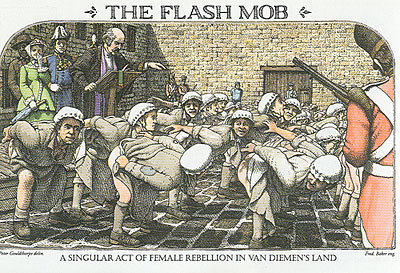
* Mass moonings - In 1832, 300 female Convicts at the Cascade Female Factory mooned the Governor of Tasmania during a chapel service. It was said that in a "rare moment of collusion with the Convict women, the ladies in the Governor's party could not control their laughter.
No comments:
Post a Comment